
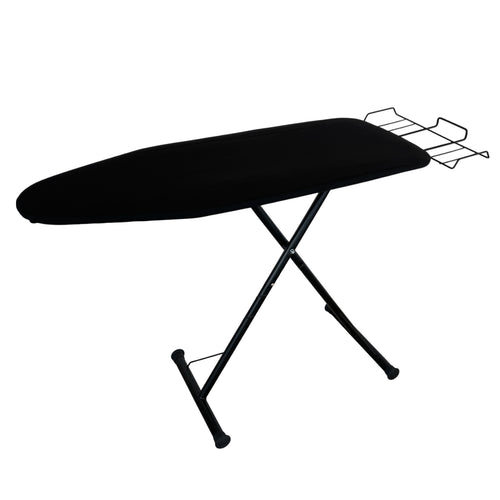

If laundry day regularly fills your home with baskets, damp clothes and temporary drying equipment, the right setup can make the routine much easier to manage. For busy households, the important question is not simply how small a clothes airer looks when stored, but how much laundry it can handle in relation to the space it occupies.
A well-chosen space-saving clothes airer should fit the way you actually wash, dry and organise clothes while keeping valuable floor space available for everyday life.
Assessing capacity against footprint
Clothes airers are often compared mainly by their dimensions, but capacity can be just as important. Footprint describes the physical space a system occupies, while capacity includes factors such as maximum load and usable hanging length. In a small home, the most practical solution is often one that provides enough drying space without permanently occupying the floor.
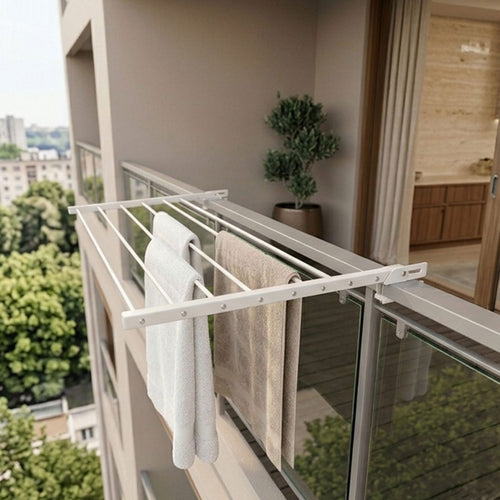
Foxydry presents ceiling-, wall-, retractable, foldable and balcony-mounted options side by side in the UK overview of Foxydry models, making it easier to compare different approaches to space-saving drying.
Start with the amount of laundry you actually dry
Before choosing between a compact model and a high-capacity drying rack, consider your busiest laundry day rather than an average single wash. Towels, bedding and everyday clothing may sometimes need to dry at the same time, and that peak demand is often a better guide to the capacity you need.
UK household data illustrates how different those needs can be. The Office for National Statistics reported 29.0 million households in the UK in 2025, with an average household size of 2.36 people. One-person households accounted for 29.5% of all households, while 66.8% consisted of one family (Families and Households in the UK: 2025).
The practical lesson is simple: there is no single ideal capacity for every home. A person living alone and washing smaller loads frequently has different requirements from a family that regularly dries towels, bedding and several loads of clothing.
Foxydry's product selector follows this same principle, asking about available space, preferred installation, frequency of use and the type of drying system required. The Foxydry selection page can therefore be used as a starting point before comparing individual models.
Finding systems that can handle larger loads
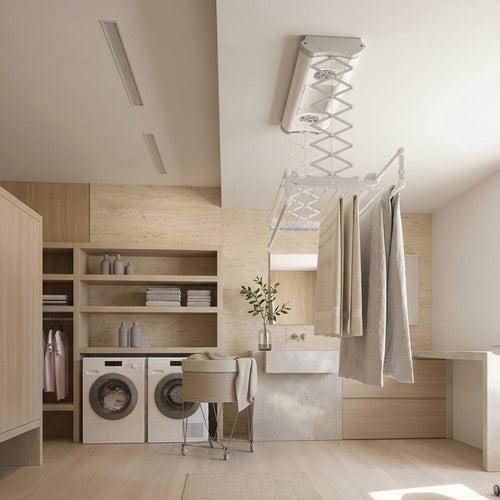
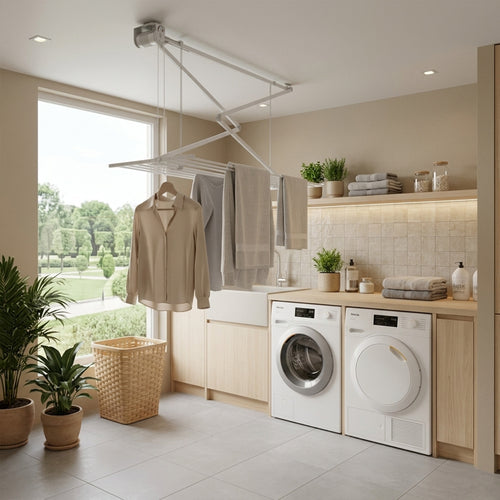
Once you understand your peak load, the next step is finding a system that can accommodate it without creating a permanent obstacle. Ceiling- and wall-mounted solutions do this by moving the drying area away from the centre of the room and making use of vertical space.
A note on capacity
A larger maximum load does not automatically make one clothes airer better than another. The useful capacity is the one that matches your normal laundry volume, available installation space and the type of textiles you dry most often. Bedding and towels, for example, may require more hanging space even when their total weight remains within the stated limit.
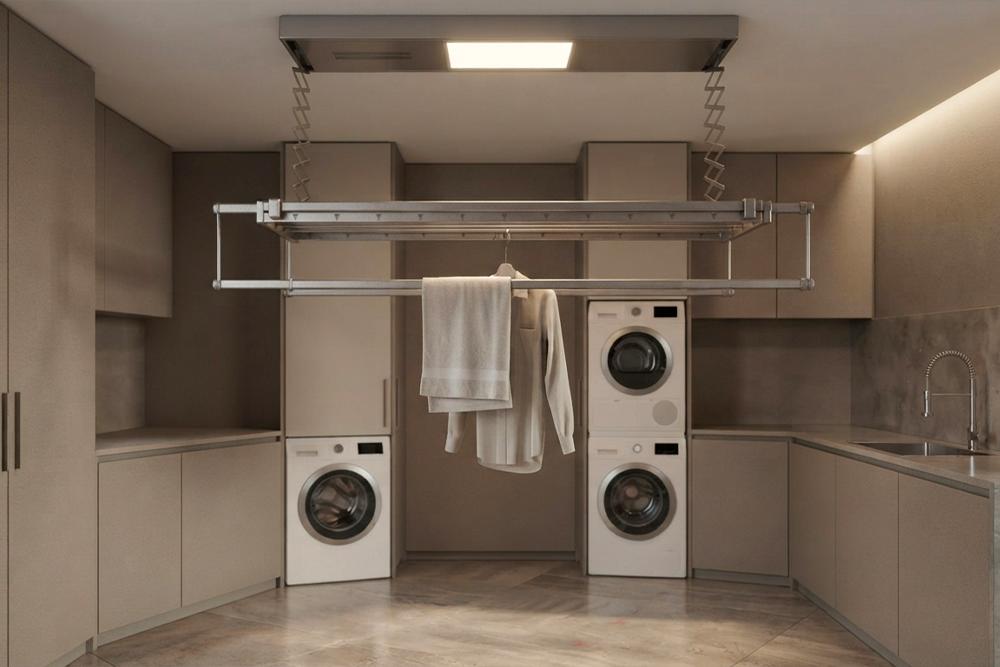
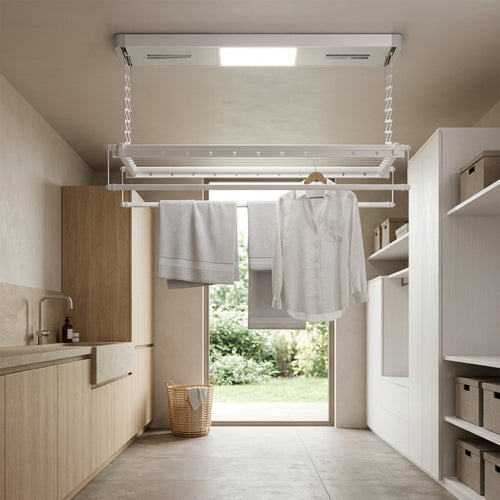
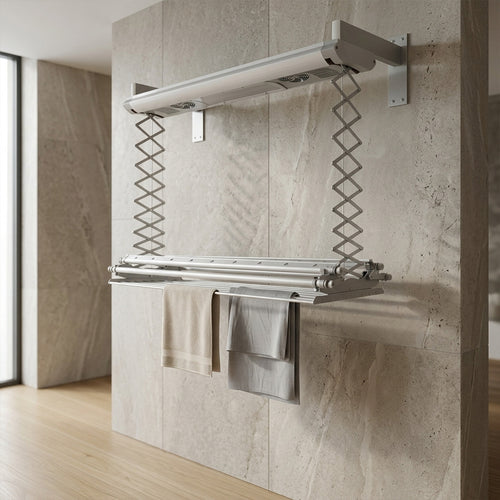
The technical specifications for Foxydry Air illustrate this approach. The motorised ceiling-mounted system supports up to 35 kg of evenly distributed laundry and is available in different lengths. Its structure lowers by remote control by up to 180 cm, allowing clothes to be loaded at a comfortable height before the rack is raised again towards the ceiling.
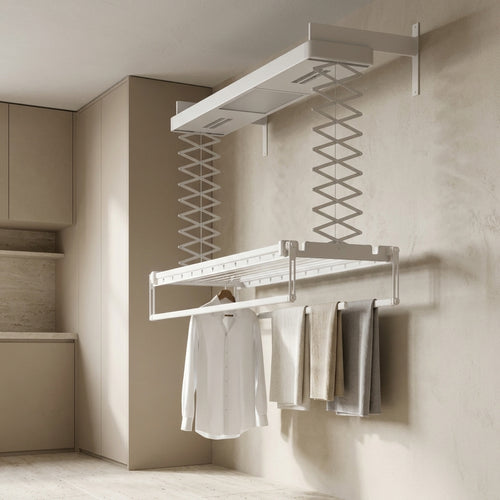
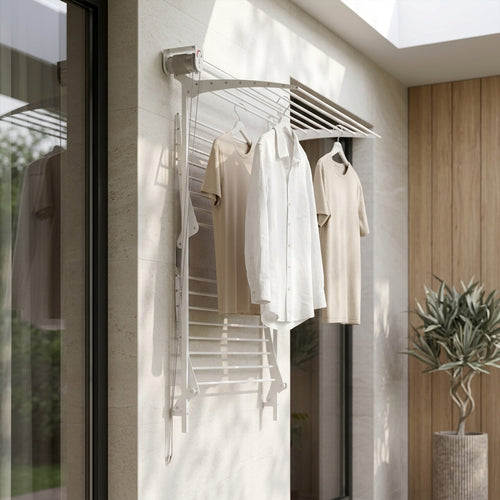
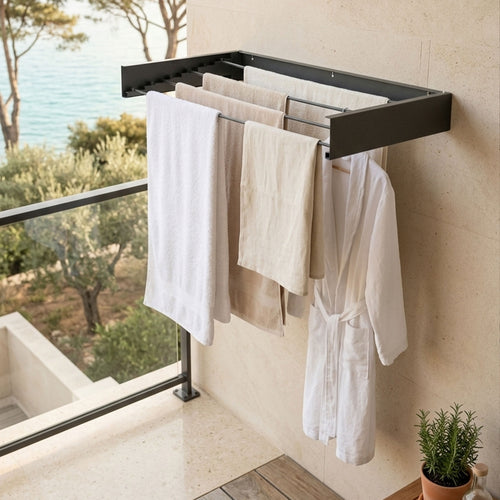
Wall-mounted systems offer another way to adapt capacity to the available room. Foxydry Wall can be configured with one, two or three racks, providing capacities of up to 10 kg, 20 kg or 30+ kg depending on the configuration. Each rack contains eight drying tubes and can be positioned against the wall when not required. The upper section can also be lowered to make loading easier (Foxydry Wall configuration).
A useful comparison therefore considers three things together: how much laundry the system can support, how much hanging space it provides and how much usable room it occupies while in operation. Foxydry's model comparison tool brings these differences together in one place.
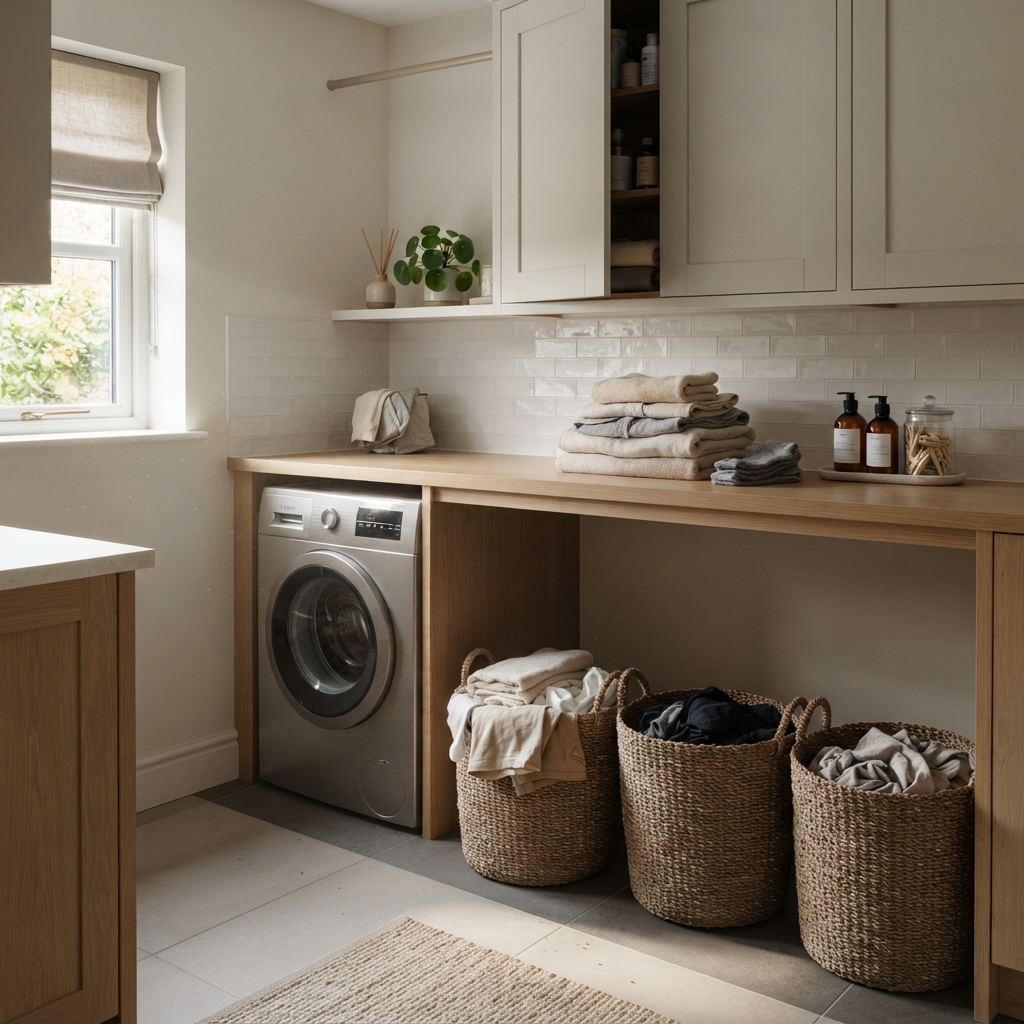
Choosing tools that simplify everyday use
Capacity answers the question “will my laundry fit?”, but ease of use determines whether a system works well in everyday life. Small inconveniences such as repeatedly lifting a heavy rack, moving furniture or squeezing past a floor-standing airer can become significant when they are repeated several times each week.
The most useful laundry tools are therefore not necessarily those with the greatest number of features. They are the ones that remove unnecessary steps from the routine.
Making loading and lowering easier
A ceiling-mounted system needs to be easy to reach when laundry is being loaded. Foxydry Air can lower by up to 180 cm using its wireless remote control and can be stopped at different heights. Safety sensors stop the movement automatically if the structure encounters an obstacle.
Air also integrates two fans with a combined power of 44 W. Their purpose is to improve air circulation around the garments and support the drying process. They do not remove moisture from the room, so adequate ventilation remains important whenever laundry is dried indoors.
Manual systems take a different approach. Foxydry Wall uses a chain-operated mechanism to move the upper drying surface, allowing it to be lowered for loading and returned upwards afterwards without using electrical power.
-
Comfort in use: consider whether the drying area can be brought to a practical loading height rather than forcing you to stretch or use a stool.
-
Control: look at how the system moves and whether it can be positioned where you need it.
-
Space after use: consider what happens once the laundry is removed. Ceiling, wall-mounted and retractable systems can return valuable room to everyday use.
Think about maintenance and repairability
A useful laundry tool should also remain practical after years of repeated use. Material quality, replaceable components and access to spare parts all contribute to the useful life of a product.
Foxydry manufactures its space-saving laundry systems in Italy using materials including aluminium and steel. Individual components can also be replaced when necessary rather than automatically replacing the entire product.
The Foxydry spare parts collection includes components such as remote controls, chains, clutches and fixing parts for different models. This makes repairability another useful criterion when comparing products that are intended to remain permanently installed in the home.
Managing indoor drying as part of the routine
Organisation alone does not determine how efficiently clothes dry. When laundry is brought indoors during autumn and winter, sufficient spacing between garments and regular ventilation remain important parts of the process.
BBC reporting on condensation and dehumidifier use has highlighted the role of indoor humidity and ventilation in managing moisture inside the home.[BBC] The same principle applies to any indoor drying setup: a clothes airer provides the space for the garments, while the room itself still needs adequate air exchange.
If you need to dry clothes indoors, open a window nearby to help dissipate damp air and speed up the drying process.[The Guardian]
Energy Saving Trust guidance also recommends making use of outdoor drying where practical and ensuring clothes have sufficient space when they are dried naturally indoors. An organised drying area can make this easier because garments can be spread out instead of being compressed onto a small temporary rack.
Considering energy use as well as convenience
Natural air drying and tumble drying serve different purposes. A tumble dryer offers speed and convenience, whereas an airer can dry laundry without the direct electrical consumption associated with the drying process itself when a manual system is used.
| Drying Method | Typical Energy Use | Direct Drying Energy Cost |
|---|---|---|
| Heat Pump Tumble Dryer | Uses electricity during each cycle | Varies by appliance and tariff |
| Condenser or Vented Tumble Dryer | Uses electricity during each cycle | Varies by appliance and tariff |
| Manual Clothes Airer | 0 kWh for the airer itself | £0 for the airer itself |
This distinction is important. A manual drying rack consumes no electricity itself, but motorised systems such as Foxydry Air do use electricity for movement, integrated lighting and ventilation. They should therefore not be described as zero-energy products.
The broader comparison is less about choosing one method for every load and more about deciding which tools make sense for the household. Some homes may rely mainly on natural air drying, while others combine an airer with occasional tumble-dryer use for particular fabrics, weather conditions or time constraints.
Build a laundry setup around your routine
The most effective laundry setup is usually the one that removes repeated obstacles from everyday life. Start with the amount of laundry you normally need to dry, then consider where the drying area can be located without blocking the room.
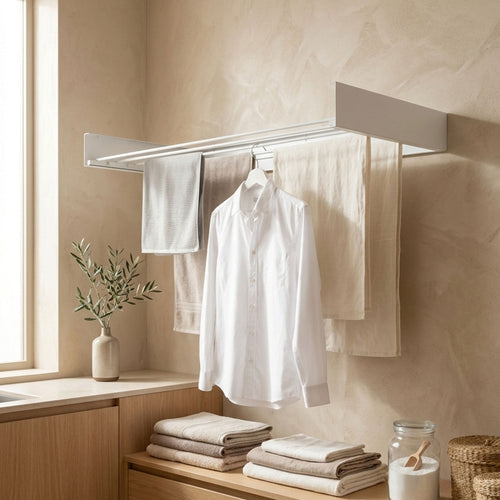
From there, compare capacity, accessibility, maintenance and energy use. A ceiling-mounted system may suit a household that needs substantial drying space while keeping the floor free; a wall-mounted system may work better where the ceiling is unavailable; and a compact manual solution may be enough for smaller or less frequent loads.
The aim is not to add more equipment to the home. It is to choose fewer, better-suited tools that make collecting, washing, drying and putting away laundry feel like one organised routine rather than a series of temporary compromises.
Sources
- [ONS, Families and households in the UK: 2025] The ONS report, Families and households in the UK: 2025
- [Find the perfect drying rack] Locate your ideal drying rack - Foxydry selection page
- [Foxydry Air] Foxydry Air technical sheet
- [Foxydry Wall configuration] Foxydry Wall configuration
- [model comparison tool] Compare Foxydry models
- [Foxydry spare parts collection] Spare parts collection
- [BBC] BBC reporting on damp-busting machines
- [Energy Saving Trust advice on home appliances] Energy Saving Trust advice on home appliances
- [Which?] The running costs of a tumble dryer
- [EcoFlow] How Much Does It Cost To Run A Tumble Dryer? 2026 Guide
- [The Guardian] Eight ways to reduce condensation in your home