
Drying clothes indoors can feel slow, cluttered and frustrating, especially during autumn and winter. The solution is not simply a bigger rack. A good indoor drying routine depends on several factors working together: the room you choose, the way air moves, how you space wet garments and how effectively moisture can leave the room. This guide explains how to dry clothes indoors more efficiently while keeping the home organised and avoiding the damp, stale conditions that can develop when moisture accumulates.
Choosing the best room for drying laundry indoors
The first decision shapes everything that follows. A good indoor drying setup starts with a room where moisture can be removed rather than allowed to accumulate. That usually means looking beyond the warmest corner of the home and choosing a space that remains usable while wet laundry is hanging.
Utility rooms, laundry areas, bathrooms with effective extraction and rooms near an opening window can all work well because they provide opportunities for air exchange while leaving enough space to hang garments without pressing them against walls or furniture.
When laundry dries indoors, the water held in the fabric does not disappear: it evaporates into the surrounding air. Research referenced by The Economic Times, drawing on work by the Mackintosh Environmental Architecture Research Unit at the Glasgow School of Art, reports that a wash load can release several litres of water vapour into the home.[The Economic Times] This helps explain why the choice of room and the way it is ventilated matter so much.
Why some rooms retain more moisture than others
Small enclosed bathrooms, spare rooms with permanently closed doors or corners of the home with little air movement can become humid relatively quickly while laundry is drying.
As the air immediately surrounding the textiles becomes more humid, evaporation becomes less effective. Condensation may also appear on colder surfaces such as windows, external walls or poorly insulated corners.
Why persistent high humidity matters
Persistently damp indoor conditions can encourage the development of mould and house dust mites. Guidance on indoor moisture therefore focuses on preventing excessive humidity from remaining trapped for long periods.[The Economic Times]
Mould: Persistent damp conditions can support mould growth on susceptible surfaces.
House dust mites: Higher humidity can also create more favourable conditions for dust mites.
Occasional indoor drying is not automatically a problem: the important point is to provide adequate ventilation and avoid repeated moisture build-up.
UK government guidance on damp and mould also explains that persistent damp and mould can affect indoor conditions and that the underlying source of moisture should be addressed rather than simply treating visible symptoms.
For indoor laundry, the practical message is straightforward: if a room repeatedly becomes very damp while clothes are drying, look at ventilation, garment spacing and the amount of laundry being dried at one time.
Balancing warmth and ventilation
Warmth can help evaporation, but heat alone is not enough. A very warm room with little air exchange can still perform poorly because the air around the laundry gradually becomes more humid.
The aim is to combine a comfortable room temperature with a route for humid air to escape. Depending on the home, that may mean opening a window periodically, using an extractor fan or creating short periods of stronger air exchange.
Brief ventilation can often be more practical than leaving a window open continuously during cold weather. The amount of time required will vary according to the size of the room, outdoor conditions and how much wet laundry is present.
The ideal drying area should also remain functional while the laundry is hanging. You should still be able to move through the room, open doors and cupboards and leave enough space around the garments for air to circulate.
The role of airflow and evaporation
Once the room itself is suitable, airflow becomes one of the most important factors. Clothes dry because moisture within the fibres evaporates into the surrounding air.
If that air remains still, the area directly around the fabric becomes progressively more humid. Moving air carries some of this moisture away and replaces it with air that can absorb more water vapour.
This is why heat alone rarely solves slow indoor drying. Air does not need to move dramatically, but it should be able to reach the surfaces of the garments and give the released moisture a route away from the drying area.
How spacing garments can improve drying
One of the simplest improvements is to avoid overcrowding the drying area.
When shirt sleeves overlap, jeans press against towels or bed linen is folded repeatedly over itself, air cannot reach the inner layers efficiently. The exterior may feel dry while thicker or folded sections remain damp.
-
Leave a visible gap between garments rather than filling every centimetre of rail space.
-
Keep thick items such as towels, hoodies and denim separated whenever possible.
-
Use hangers for shirts, blouses and similar garments when your drying system allows it.
-
Give large pieces enough support length to minimise heavy folds and bunching.
These small decisions expose more of the fabric to moving air and can make drying more even, particularly when different types of textile are being dried together.
Using cross-ventilation and natural draughts
Spacing works even better when humid air has somewhere to go. Cross-ventilation creates a route through the room, for example between an open window and a door or between two openings positioned on different sides of the space.
The important point is not simply to move humid air around the garments but eventually to remove some of that moisture from the room.
A little help from a fan
In rooms with limited natural airflow, a portable fan can help circulate air around the garments. Good Housekeeping includes a fan among its suggestions for drying laundry indoors.[Good Housekeeping] It is most useful when the moisture released from the clothes can also leave the room through ventilation, extraction or another humidity-control method.
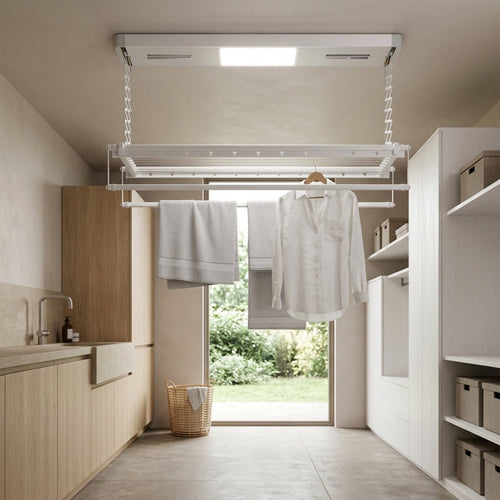
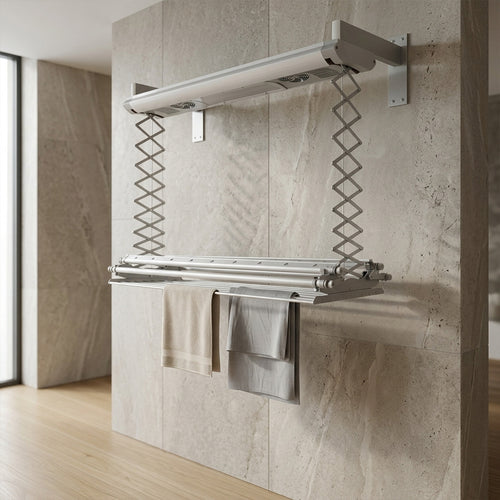
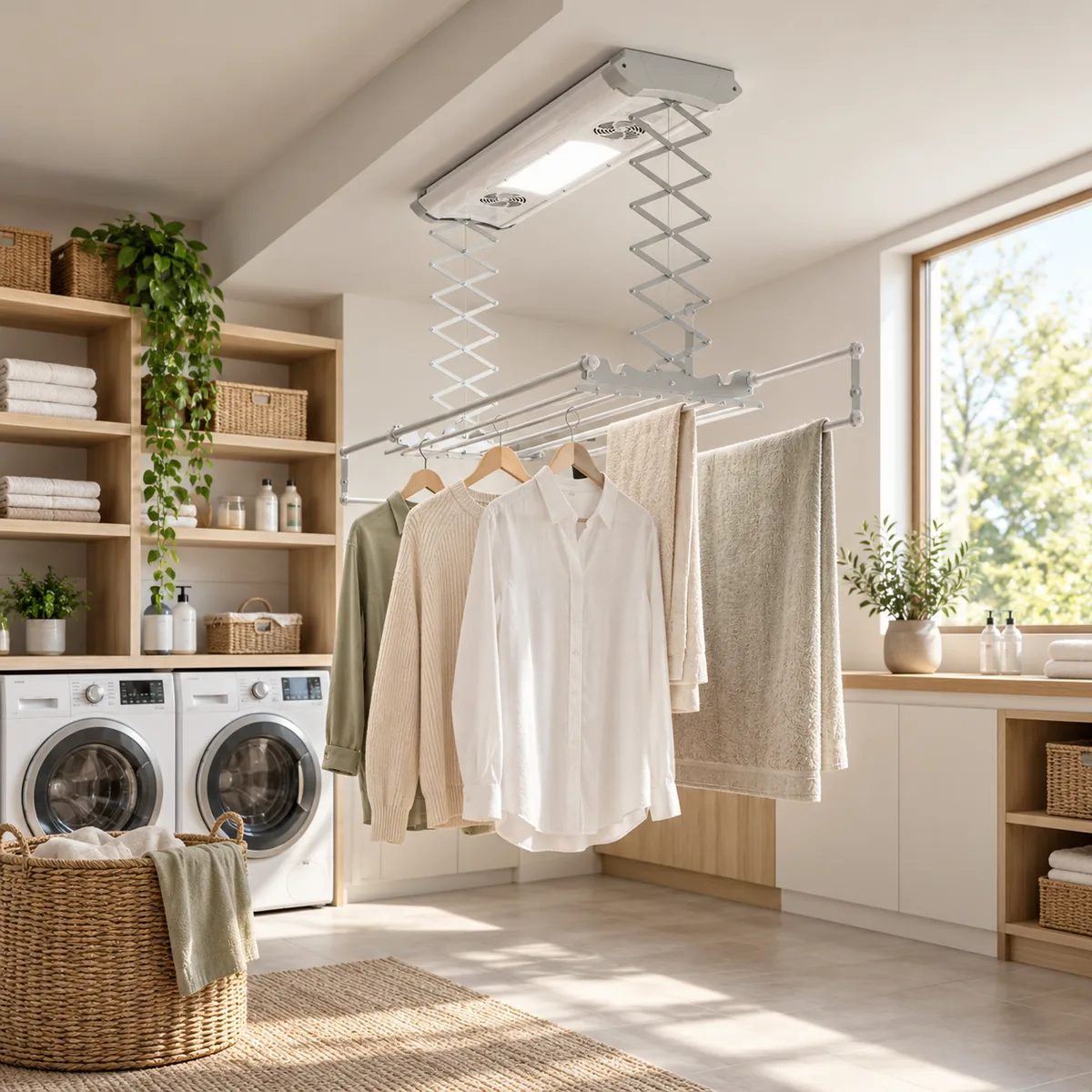
The same principle applies to drying systems with integrated ventilation. Foxydry Air, for example, uses two fans to improve air circulation around the hanging textiles. The fans support the drying process but do not dehumidify the room itself, so adequate ventilation remains important.
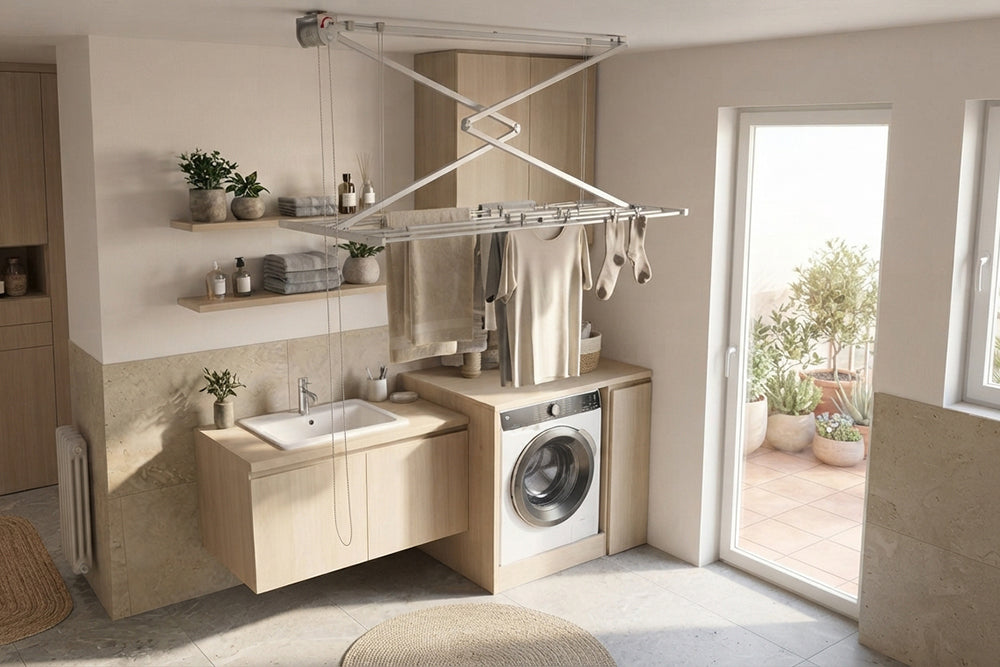
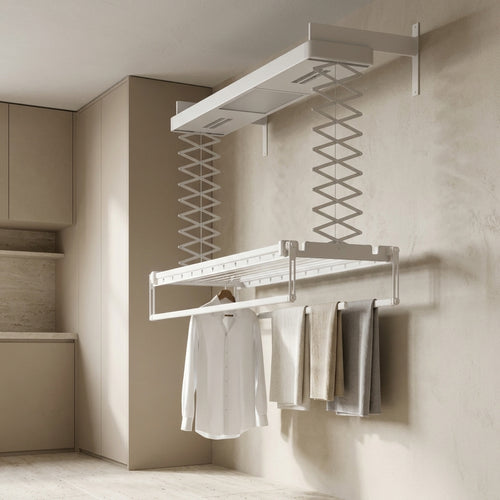
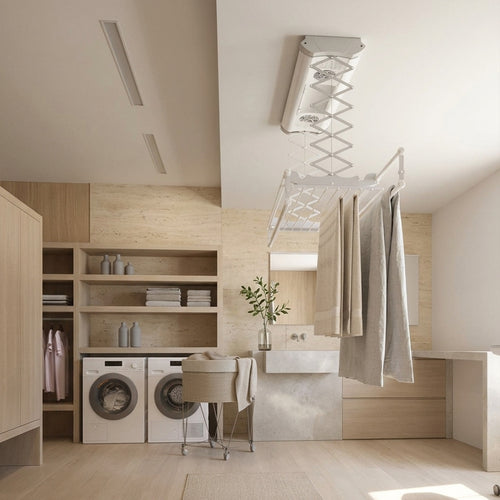
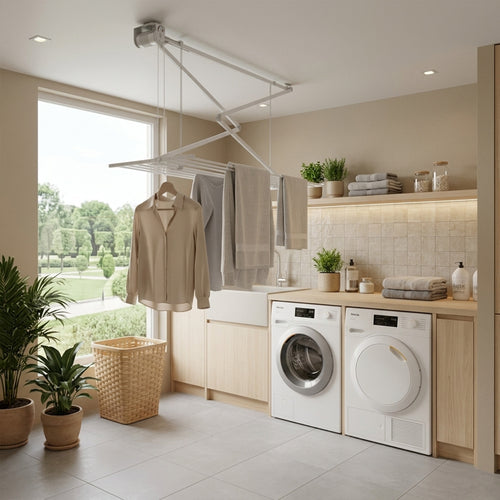
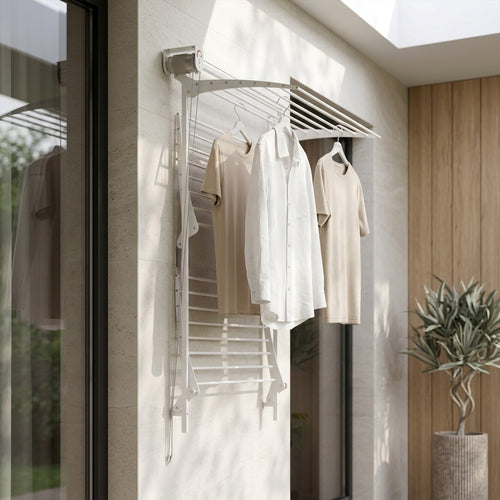
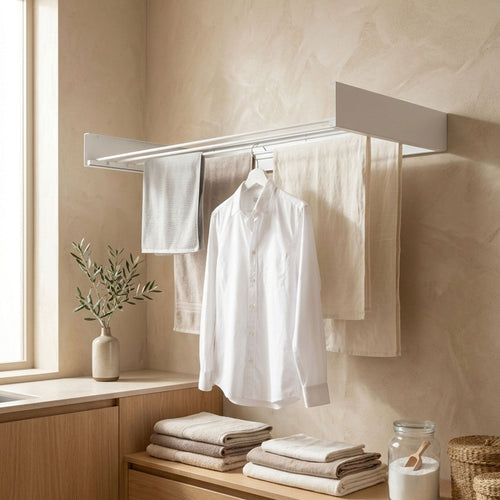
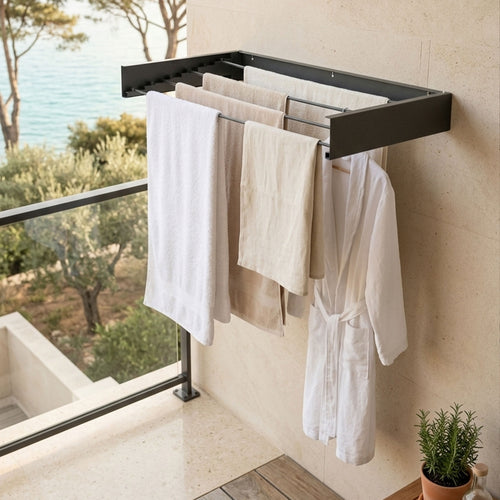
Elevated, wall-mounted and ceiling-mounted drying areas can also make the room easier to manage because they reduce the amount of floor occupied by laundry and can help keep doors, vents and walking routes clear.
Managing household humidity while laundry dries
Room choice and airflow naturally lead to humidity management. If moisture accumulates faster than it can leave the room, drying becomes progressively slower.
Repeated condensation on windows, a room that feels persistently clammy or thick textiles that remain damp for unusually long periods can indicate that the space is struggling to manage the moisture being released by the laundry.
UK government guidance emphasises that when damp or mould problems repeatedly occur, the underlying causes — including moisture sources, ventilation and condensation — need to be addressed rather than simply removing visible mould.
Extractor fans and open windows
Extractor fans can be particularly useful in bathrooms and utility areas because they remove moist air directly from the room.
If laundry is dried in a bathroom, using the extractor while the clothes are drying can therefore support moisture management. Opening a window periodically can serve the same general purpose by replacing humid indoor air with outside air.
Placement still matters. A drying rack pushed tightly against a cold wall, behind a door or into a poorly ventilated corner makes it more difficult for airflow to reach the garments.
When to consider a dehumidifier
Some homes have limited ventilation options. A single-aspect flat, a room without mechanical extraction or a layout where opening windows is difficult during colder weather can make indoor drying more challenging.
In these situations, a dehumidifier can be a useful additional tool because it actively removes moisture from the room air.

| Method | Example Energy Use (per 8 kg load) | Example Cost | Indicative Drying Time |
|---|---|---|---|
| Tumble Dryer | 2.4 kWh | ~69p | ~1 hour |
| Dehumidifier-assisted Air Drying | 0.93 kWh | ~27p | ~6 hours |
A dehumidifier is best considered an additional tool rather than the starting point of an indoor drying strategy. First choose a suitable room, then improve garment spacing and airflow. If humidity still builds up repeatedly, additional moisture control may be useful.
If condensation repeatedly appears whenever laundry is dried, or thick textiles remain damp despite reasonable spacing and ventilation, reviewing the room's humidity management can make the routine easier.
Creating a permanent indoor drying area
Once room conditions are under control, the drying system itself becomes part of the equation.
Many frustrations associated with indoor drying are actually caused by the way a temporary rack interacts with the room. If it blocks circulation, occupies the main walkway and forces garments too close together, both comfort and drying conditions suffer.
A well-integrated drying area creates a repeatable routine: there is a defined place for wet clothes, enough space between garments and less need to reorganise the room every time a washing cycle finishes.
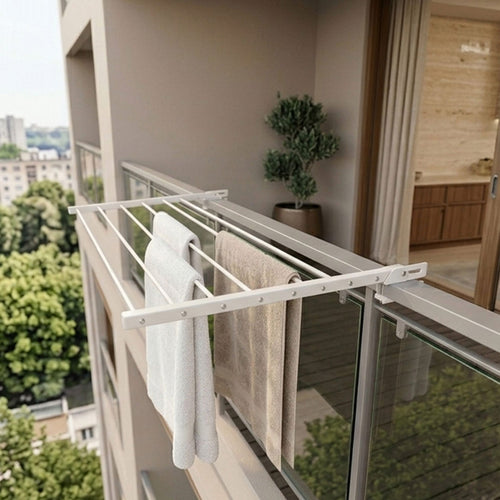
Foxydry develops space-saving drying solutions for compact homes, including ceiling-mounted, wall-mounted, folding, retractable and balcony-specific systems. The aim is to match the drying area to the layout of the home rather than automatically sacrificing floor space to a traditional rack.
The limitations of floor-standing racks
A folding floor-standing rack has an obvious advantage: it requires no installation and can be moved whenever necessary.
In a compact home, however, the same flexibility can become inconvenient. The rack occupies floor area, may obstruct walkways and is often pushed against walls or into corners when the room needs to be reclaimed.
Overloading is another common issue. When an entire wash is squeezed onto limited rail space, garments overlap and the air gaps between them become smaller.
Because the rack is temporary, the drying location may also change from one wash to the next. A dedicated drying area can make it easier to establish consistent habits around ventilation and spacing.
Using walls and ceilings instead of the floor
Wall-mounted and ceiling-mounted systems follow a different principle: they use vertical or overhead surfaces rather than occupying the centre of the room.
A ceiling-mounted clothes airer can be lowered for loading and raised again afterwards, while a wall-mounted system keeps the drying area concentrated along one side of the room. Depending on the model, folding and retractable solutions can also reduce their presence when the laundry has been removed.
The main advantage is therefore spatial. The drying area becomes a defined part of the room while more floor remains available for everyday movement.
Capacity should then be matched to the household. Foxydry offers compact manual solutions for regular loads as well as larger motorised systems capable of supporting up to 35 kg of evenly distributed laundry.
For households unsure which format best suits their room and washing habits, the Foxydry personalised drying solution selector can help compare installation types and capacities.
Materials also matter when the drying system becomes a permanent fixture. Depending on the model, Foxydry uses aluminium, anodised aluminium, stainless steel and steel, selected according to the structure and intended environment.
Drying heavy and bulky laundry indoors
Once the basic setup works well, heavier textiles become the real test. Lightweight T-shirts are relatively forgiving, while thick knitwear, denim, towels and bedding reveal weaknesses in spacing and airflow much more quickly.
These items retain more water and use more drying space, so they benefit from deliberate positioning rather than simply being added wherever there is a gap.
Thick jumpers, towels and denim
Thick garments can remain damp deep within the fibres even when their outer surface begins to feel dry. Giving them more space reduces the number of areas where two damp textiles remain in contact.
Separate heavy items when possible. Give jeans additional space around waistbands and pockets, and avoid pressing towels tightly together. Delicate jumpers may require additional support to reduce stretching while wet.
If one side remains noticeably wetter because of its position in the room, turning or repositioning the item can also help expose it more evenly to moving air.
This becomes particularly relevant during autumn and winter, when heavier clothing and household textiles return to the indoor drying routine.
Sheets and duvet covers need space to open out
Bedding creates a different challenge because of its large surface area. A sheet folded repeatedly over a short rail creates several layers through which air cannot move as easily.
Where possible, spread large textiles over a longer drying surface with fewer folds. Longer rods or extendable sections can make this easier.
Larger Foxydry ceiling-mounted systems are designed to accommodate bulkier items such as sheets and blankets. Depending on the model and size, extendable side sections increase the usable width, while the larger motorised systems can support up to 35 kg of evenly distributed laundry.
Whatever system is used, the principle remains the same: reduce bunching, expose as much fabric surface as possible and avoid allowing one large item to block airflow around the rest of the load.
Common mistakes when drying clothes indoors
Most indoor drying problems eventually return to a small number of habits: hanging too much laundry in too little space, choosing a poorly ventilated corner, relying on heat alone or leaving humid air trapped in the room.
These mistakes are easy to repeat because each seems convenient in the moment. Together, however, they can significantly slow the drying process.
Our dedicated guide to indoor drying mistakes that slow laundry down explores these habits in more detail.
Avoid drying wet garments directly on radiators
Putting wet clothes directly on a radiator may seem efficient because the fabric becomes warm quickly, but the moisture released by the textile still enters the room and still needs a way to escape.
The garment may also dry unevenly, particularly where several layers are folded together or where only one section is exposed directly to the heat.
A more balanced approach is to expose as much of the garment as possible to circulating air while using room heating to maintain comfortable general conditions.
Preventing musty smells and unnecessarily long drying times
Musty smells are more likely to develop when wet laundry remains damp for a long period, whether because it was left inside the washing machine after the cycle ended or because the drying environment could not clear moisture effectively.
-
Use an additional spin cycle when appropriate to remove more water before hanging heavier laundry.[Good Housekeeping]
-
Hang clothes soon after the washing cycle finishes instead of leaving them wet in the drum or laundry basket.
-
Match the amount of laundry to the drying space available rather than overcrowding the rack.
-
Use ventilation or extraction to give released moisture a route out of the room.
-
Create a consistent drying area so good spacing and ventilation become part of the normal laundry routine.
When these elements work together, indoor drying becomes much easier to manage. The objective is not simply to make every garment dry as quickly as possible, but to create a reliable system in which fabrics have enough space, moisture can leave the room and the drying area does not constantly interfere with everyday life.
Sources
- [The Economic Times] Does Drying Clothes Indoors Damage Your Homes Air Quality
- [Airconcentre.co.uk] Dehumidifier vs Tumble Dryer: Which is Best for Your Home?
- [Good Housekeeping] 6 creative ways to dry laundry indoors when the rain hits
- [Celtic Sustainables] Drying Laundry Indoors: Smart Tips to Keep Your Home Fresh and Free from Damp and Mould