

Why construction quality matters in everyday home products
Many home-organisation products may look similar at first glance, but their materials and construction can make a significant difference over time. Repeated loading, humidity and daily movement place stress on components, particularly in products used in bathrooms, laundry rooms and outdoor areas. Assessing construction quality therefore means looking beyond appearance and considering what carries the load, how that load is distributed and whether individual components can be maintained or replaced.
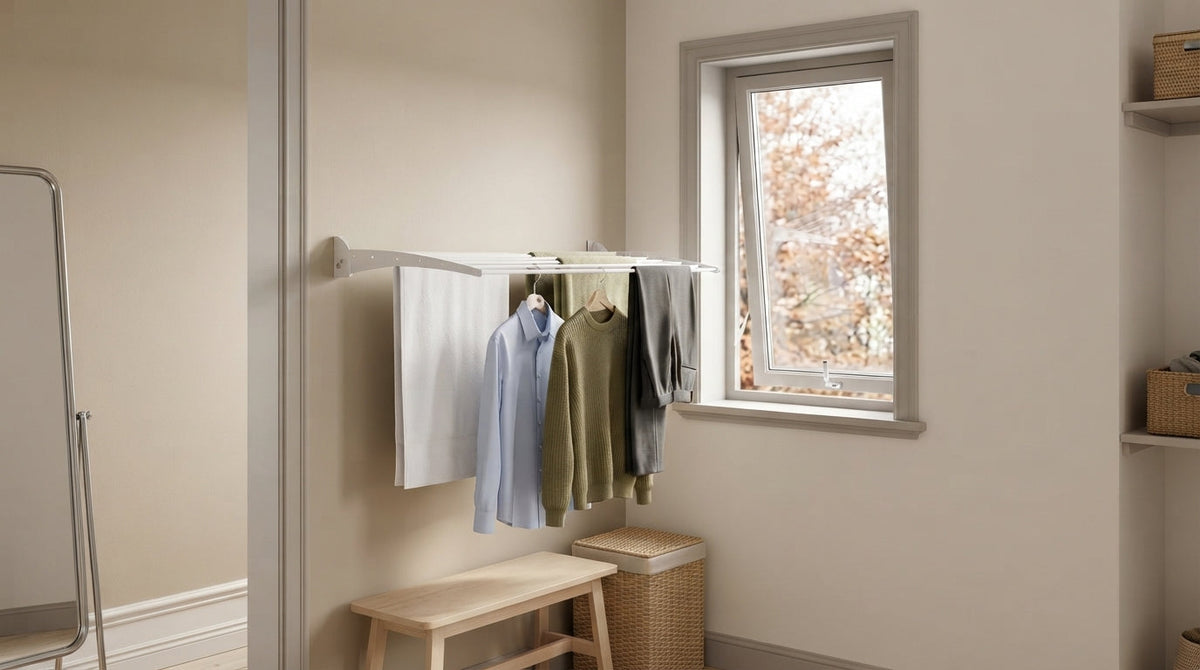
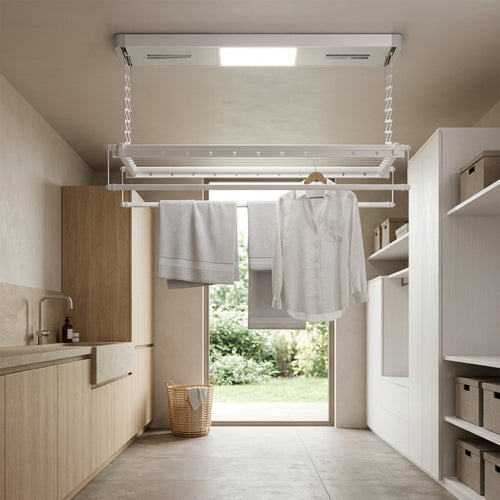
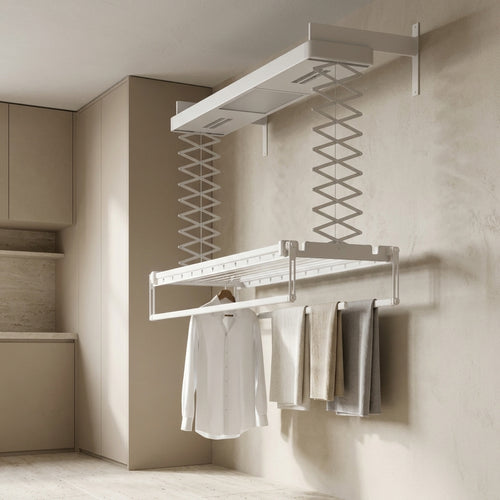
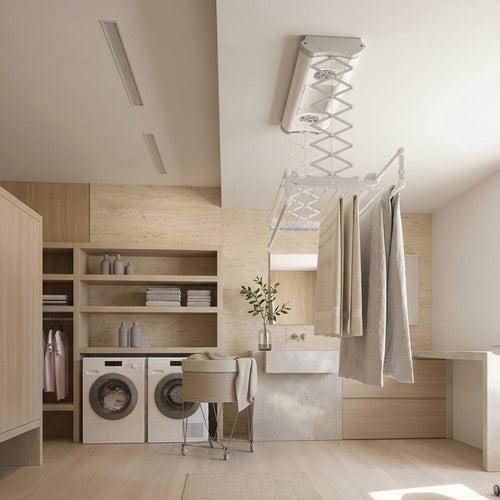
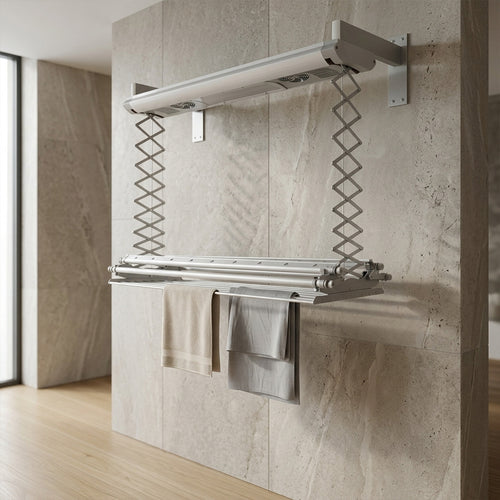
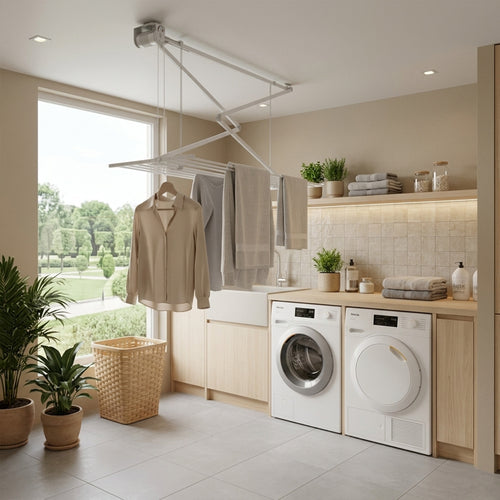
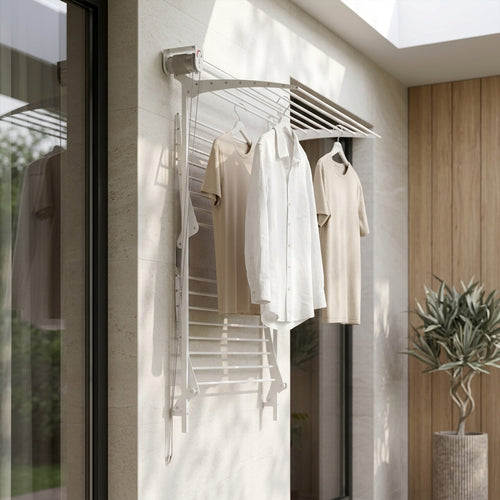
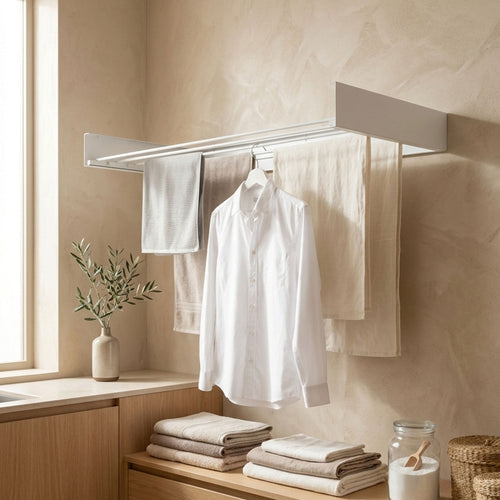
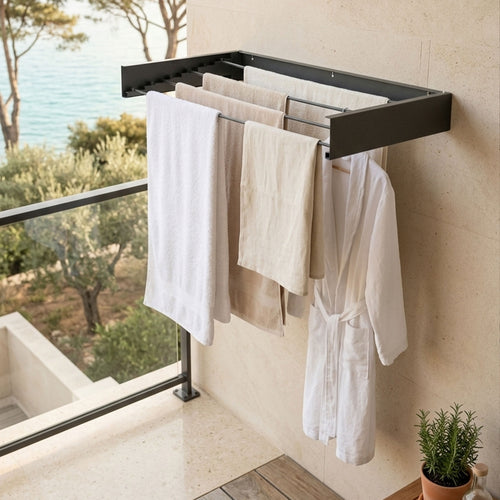
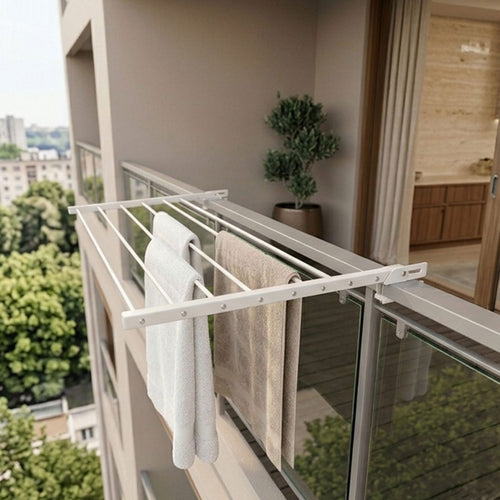
One useful benchmark is structural clarity. Load capacities should be clearly stated, installation requirements should be documented and the mechanisms used to support or move the load should be appropriate for their intended purpose. Within the Foxydry range, for example, a compact manual ceiling-mounted model can support up to 10 kg, while motorised ceiling systems can support up to 35 kg. Wall-mounted configurations can range from 10 kg with one rack to 20 kg with two racks and more than 30 kg with three racks.
Good construction also considers what happens after years of use. Materials such as aluminium and stainless steel are used extensively in products designed for humid environments, while replaceable components can help extend the useful life of a product. Foxydry, for example, offers replacement remote controls, chains, clutches and clips rather than requiring the complete product to be replaced when an individual component wears out. The range of Foxydry spare parts illustrates this approach.
Why material choice matters for structural plastic parts
Plastic is not inherently a poor material. Different polymers can perform extremely well when they are correctly selected and engineered for a specific application. Problems can arise, however, when a plastic component is undersized or used for a structural load that exceeds what the material and geometry were designed to withstand over time.
One factor engineers consider is time-dependent deformation, or creep. In materials science, creep describes the gradual deformation of a material when it remains under sustained mechanical stress. This phenomenon is particularly relevant when evaluating polymer components intended to carry a continuous load.[Evok Polymers]
What is plastic creep?
Creep is the time-dependent deformation that can occur when a plastic component remains under continuous mechanical stress, even when the applied load is below the material's short-term failure point.[Evok Polymers] The extent of creep depends on factors including the polymer, component geometry, temperature, stress level and duration of loading.
Standards such as ASTM D2990 and ISO 899-1 are used to measure the creep behaviour of plastics under sustained loads.[Evok Polymers] Testing helps engineers understand how much a component may deform over time and whether the selected material and geometry are appropriate for its intended application.
In a household product, this matters because gradual deformation may affect alignment, movement or structural stability long before a component breaks completely. The relevant question is therefore not simply whether a material is plastic or metal, but whether it has been appropriately designed for the mechanical load it must carry.
Humidity and outdoor exposure add further considerations. Laundry equipment is frequently used in bathrooms, utility rooms, balconies and terraces, where components may come into contact with moisture or wet textiles. Materials, surface treatments and moving parts should therefore be selected for the conditions in which the product will actually be used.
Why anodised aluminium is used in durable products
Aluminium is widely used where manufacturers need a combination of relatively low weight, corrosion resistance and structural performance. When aluminium is anodised, an electrochemical process increases the thickness of the naturally occurring oxide layer on its surface.[Protolabs]
This treatment can improve corrosion and wear resistance while creating a surface layer that is integrated with the aluminium rather than applied like a conventional paint coating. Before sealing, the anodised layer is porous and can also be coloured if required.[Protolabs]
The anodising process follows a sequence of controlled stages designed to prepare and protect the metal surface.[Protolabs]
-
Pre-treatment: The aluminium is cleaned and degreased and may be etched to produce a uniform surface.
-
Anodising: The component is immersed in an electrolyte, commonly based on sulphuric acid, and an electric current promotes the formation of a thicker aluminium oxide layer.
-
Colouring (optional): The porous oxide layer can absorb a dye when a coloured finish is required.
-
Sealing: The pores in the oxide layer are closed to improve protection and, where applicable, retain the chosen colour.
| Material Condition | Reported Hardness (Rockwell C Scale) |
|---|---|
| Unanodised Aluminium | 38 to 44 |
| Anodised Aluminium | 48 to 55 |
| Hardcoat Anodised Aluminium | 60 to 70 |
These figures illustrate how surface treatment can change the properties of aluminium, although the exact result depends on alloy, anodising process and coating specification. Protolabs also identifies improved corrosion resistance and wear resistance among the main advantages of anodising.[Protolabs]
For household products, this combination can be useful when components need to remain relatively light while being repeatedly handled or exposed to moisture. The same principle applies to other material choices: aluminium, stainless steel and suitably protected metals can each be appropriate depending on the component and intended environment.
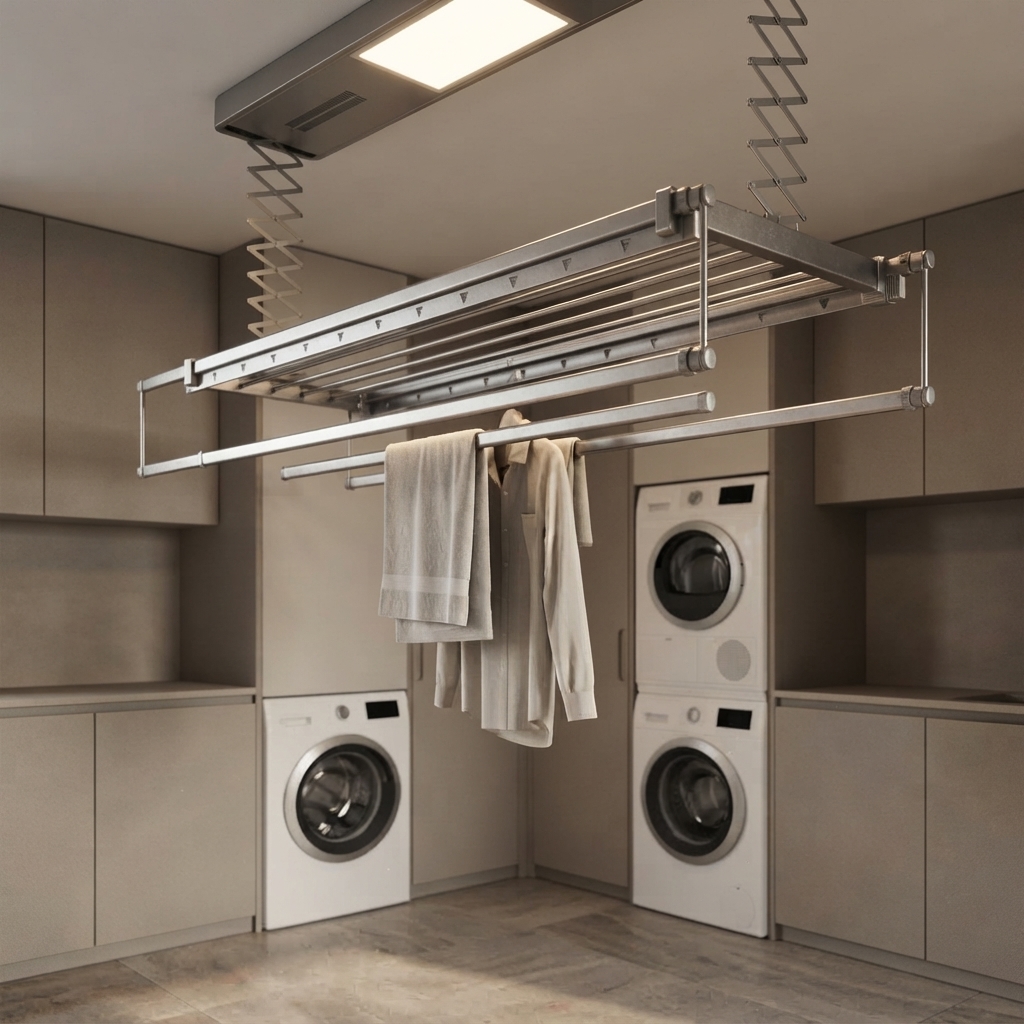
Weight is particularly relevant for products that move. A ceiling-mounted structure that lowers and rises repeatedly benefits from components that combine strength with manageable mass. Foxydry Pro, for example, can lower by up to 180 cm and support up to 35 kg of evenly distributed laundry, while Foxydry Mini supports up to 10 kg with a manual lifting mechanism.
Material quality therefore should not be understood simply as a premium finish. It is part of the relationship between weight, movement, moisture resistance, load capacity and long-term maintenance.
Safety depends on materials, design and installation
Material choice is only one part of product safety. A household system also needs to behave predictably when it is loaded, moved and used repeatedly. This is particularly important for wall- and ceiling-mounted drying systems, which may be positioned above appliances, worktops or areas people regularly walk beneath.
Different mechanisms address this in different ways. Motorised Foxydry systems use sensors that automatically stop movement when an obstacle is detected. Manual models use mechanical systems designed to make raising and lowering the rack more controlled. Wall-mounted products distribute the load across multiple fixing points, with the number of anchoring points depending on the model and configuration.
Managing heavy and uneven loads
Wet laundry can be considerably heavier than dry laundry, particularly when a load includes towels, jeans, bedding or other thick textiles. This is why a clearly stated maximum capacity is an important part of product specification.
Within the Foxydry range, motorised ceiling models can support up to 35 kg, Foxydry Mini up to 10 kg and current Foxydry Wall configurations range from 10 kg with one rack to 20 kg with two racks and more than 30 kg with three racks. Other wall-mounted and retractable products have their own stated capacities according to their construction.
Maximum capacity is only one part of safe use. Laundry should also be distributed across the available structure rather than concentrated unnecessarily on one side. A large wet textile placed entirely on one section creates a different load pattern from several garments distributed across multiple rods.
This is why measurable specifications are more useful than vague claims of strength. Knowing the intended load and installation method makes it easier to use a product within the conditions for which it was designed.
Installation is part of structural performance
Even a well-designed product depends on suitable installation. Wall and ceiling construction varies considerably between homes, so the fixing method must be appropriate for both the substrate and the expected full-load weight.
Motorised Foxydry ceiling systems also require an electrical connection. The manufacturer recommends professional installation where necessary, particularly when electrical work or uncertainty about the supporting structure is involved. Plasterboard, suspended ceilings and other non-solid substrates may require reinforcement or specialised fixings.
For product-specific installation information, consult the Foxydry installation instructions before fitting or loading the system.
Manufacturing consistency also matters. A well-designed component needs to be produced repeatedly within controlled tolerances so that replacement parts, installation instructions and assembly procedures remain dependable.
- Industry 4.0
- The digital transformation and integration of industrial operations with business processes and information technology.[Cisco]
Industry 4.0 describes the integration of connected technologies, industrial processes, business operations and IT with the aim of making manufacturing more efficient, flexible and responsive.[Cisco] In practical terms, digital production systems can support repeatability, process control and traceability.
For a manufacturer, this matters because consistent production makes technical documentation and spare-part availability more useful. Replacement components only deliver their full value when products are manufactured to sufficiently consistent specifications.
The broader lesson is that durable household products depend on several factors working together: appropriate materials, realistic load ratings, controlled movement, suitable installation and the ability to maintain or repair individual components.
Choosing higher-quality home-organisation products therefore does not have to be about adding more features. It can simply mean choosing a product whose materials, construction and support are designed around repeated everyday use, reducing the need for premature replacement over time.
Sources
- [Evok Polymers] Creep Resistance Testing for Plastic Parts
- [Protolabs] Benefits of Aluminum Anodizing for Metal Parts
- [Incertec] Anodized aluminium vs stainless steel corrosion
- [Cisco] What Is Industry 4.0?