

Understanding the mechanics of overhead drying
Choosing between a manual and a motorised ceiling clothes airer is not simply a question of technology. The right system depends on how much laundry you usually dry, how frequently you use it, the space available and the level of convenience you want in your everyday routine.
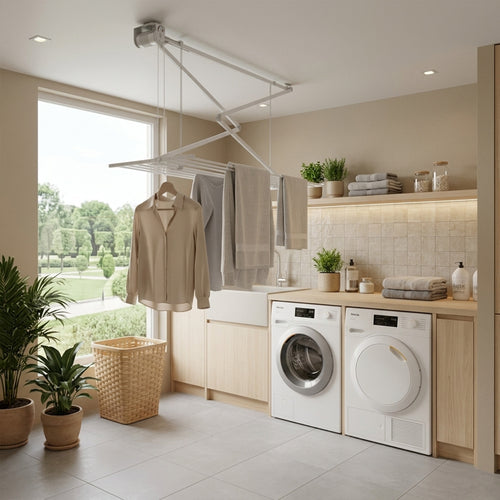
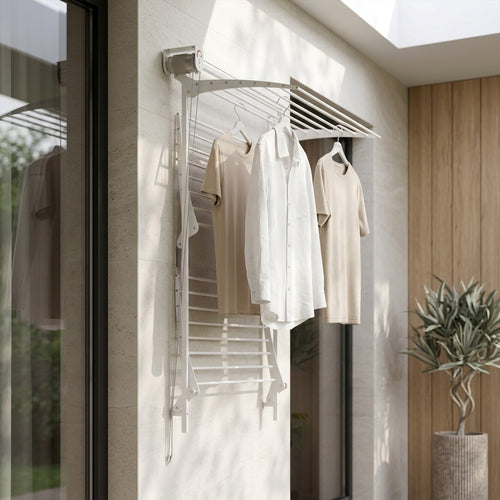
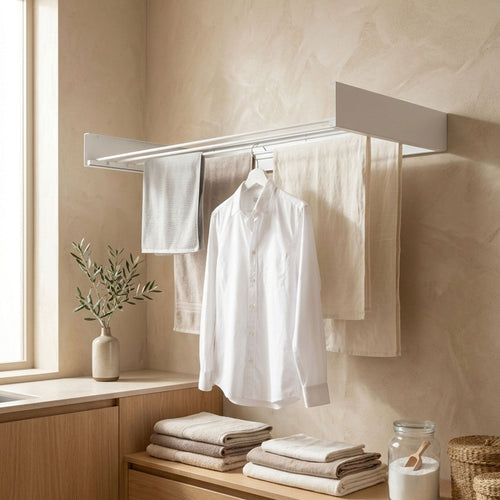
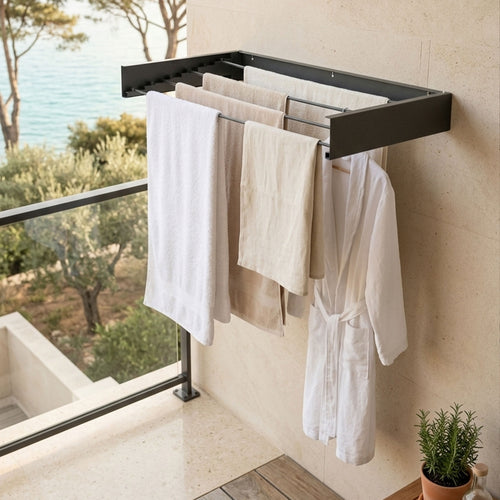
A ceiling-mounted clothes airer moves the drying area away from the floor and makes use of otherwise underused overhead space. This can help keep walkways clear and reduce the need for a folding floor-standing rack. Commercial market research also points to continued interest in compact drying solutions as homes become increasingly space-conscious.[Persistence Market Research]
Why overhead drying systems are attracting attention
Market research on electric clothes drying racks forecasts continued growth in the category, linking demand to urban living, limited domestic space and interest in alternatives to conventional tumble drying.[TechSci Research]
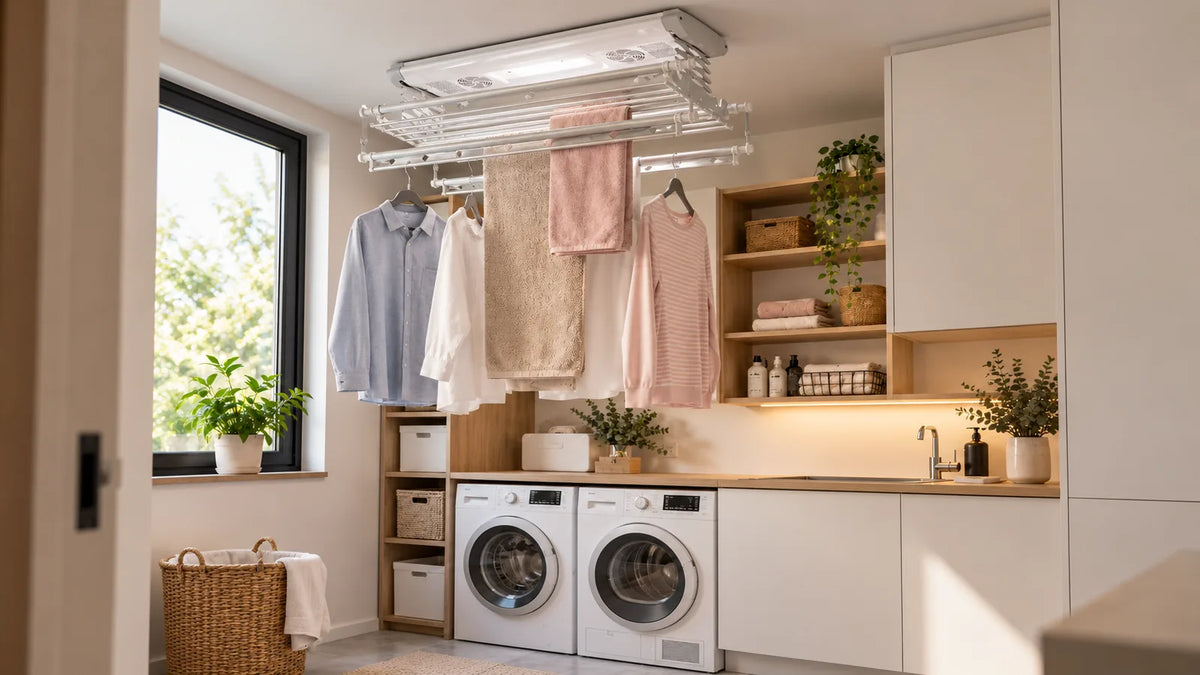
The principle is straightforward: the rack lowers to a comfortable height for loading and can then be raised again while the laundry dries. Both Foxydry Mini and Foxydry Air can descend by up to 1.80 metres. From that shared starting point, the main difference is how the system moves and how much assistance, capacity and functionality you need.
How a manual ceiling clothes airer works
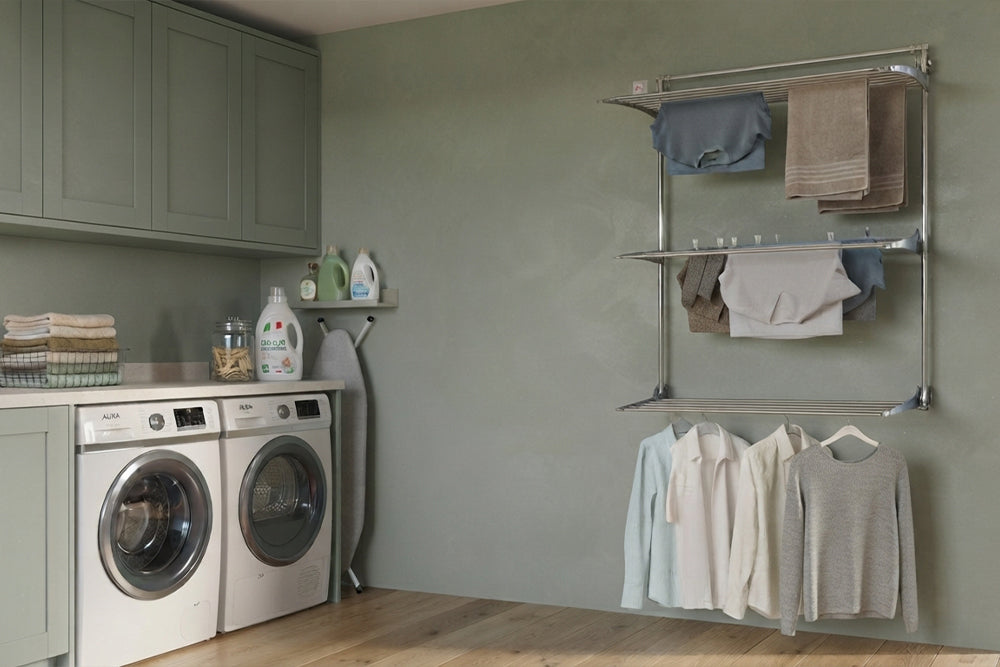
A manual ceiling airer provides mechanical rather than electronic assistance. Foxydry Mini uses a manual chain and friction mechanism designed to make raising and lowering the loaded rack easier than lifting the full weight directly.
The rack can be stopped at different heights and lowered by up to 1.80 metres. It supports up to 10 kg of evenly distributed laundry and uses eight drying rods. Depending on the size selected, the available drying length reaches up to approximately 11.5 metres.
This type of system suits households looking for a permanent, space-saving ceiling solution without an electrical connection. Because the movement is entirely mechanical, installation planning is simpler than for a powered model.
Materials such as steel, anodised aluminium and moisture-resistant cords are used in the structure. A manual system therefore does not necessarily mean a temporary or basic solution: the main difference lies in how the rack is operated.
How a motorised ceiling clothes airer works
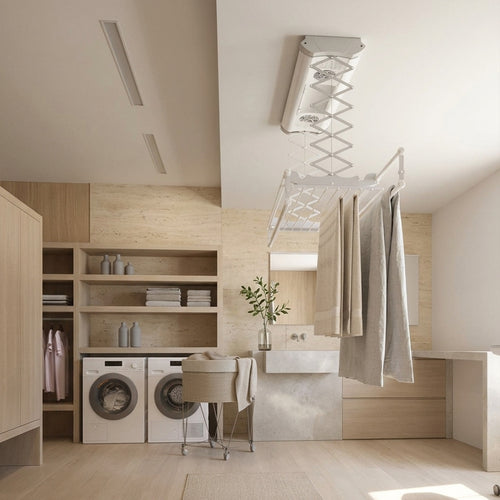
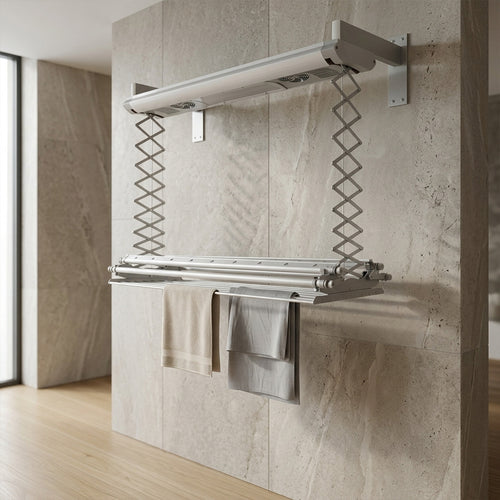
A motorised ceiling airer follows the same space-saving principle but replaces manual movement with an electric motor. Foxydry Air is controlled remotely and can be lowered by up to 1.80 metres, stopping at the required height.
Its maximum load capacity is up to 35 kg, giving considerably more flexibility for households that regularly need to manage larger quantities of laundry, towels, bedding or other bulky textiles.
Foxydry Air also adds functions that are not present on the manual Mini. These include two integrated air-circulation fans, LED lighting, obstacle detection and extendable side rails designed to accommodate larger items such as sheets.
The integrated fans use a total of 44 W and help move air around the hanging textiles, supporting the drying process. They do not dehumidify the room itself, so adequate ventilation remains important whenever laundry is dried indoors.
Air-drying clothes avoids the electricity required by a conventional tumble dryer during the drying cycle and can also provide a gentler option for many fabrics. The actual energy saving depends on the appliances, functions and drying habits used in each household.
The motorised movement, integrated lighting and ventilation make Air particularly suitable for households where the drying rack is used frequently or where handling larger loads manually would be less convenient.
See the specifications side by side using the Foxydry model comparison.

Manual vs motorised: comparing the two systems
Once the operating principles are clear, the choice becomes much easier. Both Mini and Air move laundry away from the floor, but they are designed around different priorities. Mini focuses on mechanical simplicity and compact everyday use, while Air adds powered movement, greater load capacity and integrated functions.
| Feature | Foxydry Mini (Manual) | Foxydry Air (Motorised) |
|---|---|---|
| Operation | Manual chain and friction mechanism | Remote-controlled electric motor |
| Load capacity | Up to 10 kg | Up to 35 kg |
| Maximum lowering distance | Up to 1.80 m | Up to 1.80 m |
| Key features | Non-electric, mechanically assisted movement | LED light, air-circulation fans, obstacle detection, extendable side rails |
| Typical use | Regular household loads and compact spaces | Larger or more frequent loads and bulky textiles |
| Electrical connection | Not required | Required |
Neither system is automatically the better choice. The useful comparison is which one fits your room, typical laundry volume and preferred level of assistance.
Installation and long-term use
Installation is another important difference between a manual and a motorised ceiling clothes airer.
Foxydry Mini does not require an electrical connection, which can make it easier to integrate into an existing bathroom, utility room or laundry area. The ceiling itself must still be suitable for the fixing system and expected load.
Foxydry Air also becomes a permanent ceiling fixture but requires both secure anchoring and an electrical supply. Planning the location before installation is therefore particularly important.
Foxydry provides dedicated instructions on the Foxydry Air installation page and Foxydry Mini installation page.
For both systems, durability depends not only on the materials used in the rack but also on correct installation, appropriate use and respecting the stated maximum load.
Foxydry uses materials including anodised aluminium and steel in its ceiling systems, combining permanent installation with the ability to move the drying surface away from the main living area when it is not being loaded or unloaded.
Which system suits your laundry volume?
The amount and type of laundry you normally handle is one of the clearest ways to distinguish between the two models.
If you usually dry one regular wash at a time and your main objective is to remove a floor-standing airer from the room, the 10 kg capacity of Foxydry Mini may be sufficient. Its mechanical operation also suits households that specifically want a non-electric solution.
For larger households, frequent washing or bulky textiles, the 35 kg capacity of Foxydry Air provides considerably more flexibility. Its extendable side rails are also useful when drying longer items such as sheets.
The difference becomes particularly noticeable with repeated use. Both systems can be lowered to a convenient loading height, but Mini is raised manually using its assisted mechanism, whereas Air moves at the touch of the remote control.
-
A manual ceiling airer may suit you if you usually handle moderate laundry loads, prefer a non-electric mechanism and want a simple permanent ceiling solution.
-
A motorised ceiling airer may suit you if you regularly manage larger loads, bulky textiles or frequent washing and value remote-controlled movement and integrated functions.
Rather than focusing only on the initial difference between manual and electric operation, consider how the system will be used week after week. A ceiling clothes airer becomes part of the room, so capacity, ease of use and installation should reflect your actual household routine.
Both Foxydry Mini and Foxydry Air follow the same underlying idea: use the ceiling for drying and keep valuable floor space available for everyday life. The difference is how much capacity and assistance you want from the system.
[Persistence Market Research] Persistence Market Research, Cloth Drying Racks Market Analysis, 2026-2033.
[TechSci Research] TechSci Research, Global Electric Clothes Drying Rack Market Report, 2021-2031F.